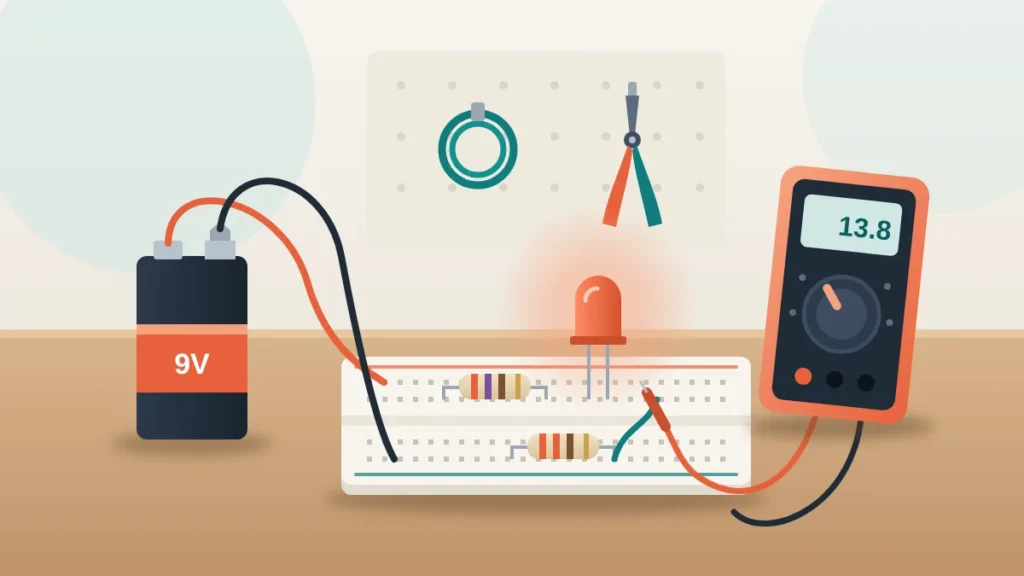
Ohm’s law says the voltage across a resistor equals the current through it times its resistance: V = I × R. Rearranged, current is I = V ÷ R and resistance is R = V ÷ I. Put 12 volts across a 220-ohm resistor and 12 ÷ 220 = 0.0545 A, or 54.5 mA, flows through it.
That single relationship lets you size resistors, predict current draw, check whether a wire or part will overheat and troubleshoot a circuit with nothing more than a multimeter. You can solve any of the three values instantly with our Ohm’s law calculator. This guide explains what each quantity means, adds the power formulas you need to choose parts safely, and works through series, parallel and LED circuits with real numbers.
Voltage, current and resistance in plain terms
The classic analogy is water in a pipe. It is not perfect, but it gets the intuition right.
- Voltage (V, measured in volts) is the push, like water pressure. It is always measured between two points: a 9 V battery has 9 volts between its terminals.
- Current (I, in amperes or amps, A) is the flow, like liters per second. It is the rate at which charge moves: 1 ampere is one coulomb of charge per second.
- Resistance (R, in ohms, Ω) is how hard the path resists flow, like a narrow section of pipe. One ohm is the resistance that lets 1 amp flow when 1 volt is applied.
The units are part of the International System of Units; the NIST page on SI units lists how the volt, ampere and ohm relate to each other. Georg Ohm published the relationship in 1827 after experiments with wires of different lengths, and it has been the first equation in every electronics course since.
The Ohm’s law triangle: three formulas from one
Because V = I × R is a simple product, you can solve for whichever value is missing:
| You know | You want | Formula | Example |
|---|---|---|---|
| Current and resistance | Voltage | V = I × R | 0.02 A × 470 Ω = 9.4 V |
| Voltage and resistance | Current | I = V ÷ R | 5 V ÷ 1,000 Ω = 5 mA |
| Voltage and current | Resistance | R = V ÷ I | 12 V ÷ 0.5 A = 24 Ω |
Many students draw a triangle with V on top and I and R at the bottom. Cover the value you want, and what is left shows the operation: covering V leaves I × R, covering I leaves V over R.
Watch your prefixes. Electronics is full of milliamps (mA, thousandths of an amp) and kilohms (kΩ, thousands of ohms). Conveniently, volts ÷ kilohms gives milliamps directly: 9 V ÷ 1 kΩ = 9 mA. Mixing up mA and A is the single most common error in Ohm’s law problems.
Adding power: P = V × I
Ohm’s law tells you how much current flows. The power formula tells you how much heat that current makes, which decides whether a part survives.
P = V × I = I² × R = V² ÷ R
All three forms give the same answer; pick the one that uses the values you already have. Power is measured in watts (W). For the 12 V, 220 Ω example above: P = 12² ÷ 220 = 144 ÷ 220 = 0.65 W. A standard quarter-watt resistor would cook. You would want a 1 W part, or better a 2 W part, since the usual rule of thumb is to rate a resistor for at least twice the power it actually dissipates. The Ohm’s law and power calculator gives you all four values (V, I, R and P) from any two, and the resistor wattage calculator suggests a safe rating.
Power also explains household numbers. A 1,500 W space heater on a 120 V outlet draws 1,500 ÷ 120 = 12.5 A, and its heating element has a hot resistance of 120 ÷ 12.5 = 9.6 Ω. That is why one heater can nearly max out a 15 A circuit on its own. The watts to amps calculator does this conversion for AC and DC loads.
Resistors in series
Components in series sit end to end on a single path, so the same current flows through every one. Resistances simply add:
R_total = R₁ + R₂ + R₃ + …
Worked example: three resistors on a 9 V battery
Connect 100 Ω, 220 Ω and 330 Ω in series across 9 V.
- Total resistance: 100 + 220 + 330 = 650 Ω.
- Current (same everywhere): I = 9 ÷ 650 = 13.8 mA.
- Voltage across each resistor, using V = I × R:
- 100 Ω: 0.01385 × 100 = 1.38 V
- 220 Ω: 0.01385 × 220 = 3.05 V
- 330 Ω: 0.01385 × 330 = 4.57 V
- Check: 1.38 + 3.05 + 4.57 = 9.00 V. The drops always add up to the supply voltage (Kirchhoff’s voltage law).
The biggest resistor takes the biggest share of the voltage. This is exactly how a voltage divider works, and the voltage divider calculator solves the two-resistor case directly. For longer chains, use the series resistor calculator.
Resistors in parallel
Components in parallel share the same two connection points, so each one sees the full supply voltage, and the currents add. The combined resistance is always smaller than the smallest single resistor:
1 ÷ R_total = 1 ÷ R₁ + 1 ÷ R₂ + 1 ÷ R₃ + …
Using the same three resistors in parallel on 9 V:
- Current through 100 Ω: 9 ÷ 100 = 90.0 mA
- Current through 220 Ω: 9 ÷ 220 = 40.9 mA
- Current through 330 Ω: 9 ÷ 330 = 27.3 mA
- Total current: 158.2 mA, so R_total = 9 ÷ 0.1582 = 56.9 Ω
For two resistors there is a shortcut, product over sum: R = (R₁ × R₂) ÷ (R₁ + R₂). Two equal resistors in parallel always give half the value. The parallel resistor calculator handles up to ten resistors and can also find the missing value needed to hit a target.
| Property | Series | Parallel |
|---|---|---|
| Current | Same through every part | Splits between branches |
| Voltage | Splits between parts | Same across every branch |
| Total resistance | Sum of all | Less than the smallest |
| If one part fails open | Everything stops | Other branches keep working |
| Everyday example | Old string of holiday lights | Outlets in a house |
Worked example: choosing an LED resistor
This is where most hobbyists first use Ohm’s law for real. An LED is not a resistor: it drops a roughly fixed “forward voltage” (about 2.0 V for red, 3.0–3.3 V for blue and white) and will draw as much current as the circuit allows until it fails. A series resistor sets the current.
The job: run two red LEDs in series from a 9 V battery at 20 mA.
- Voltage the resistor must drop: 9 − (2 × 2.0) = 5.0 V.
- Resistance: R = 5.0 ÷ 0.020 = 250 Ω.
- Pick a standard value at or above that. 250 Ω is not in the common E12 series, so use 270 Ω.
- Actual current: 5.0 ÷ 270 = 18.5 mA, slightly below 20 mA, which is fine and extends LED life.
- Resistor power: I² × R = 0.0185² × 270 = 0.093 W. A quarter-watt resistor has plenty of margin.
The LED resistor calculator runs this for any color, number of LEDs and series or parallel layout. To read the value off the resistor itself, the resistor color code calculator decodes the bands (270 Ω is red, violet, brown). Resistors have a tolerance, often ±5%, so a 270 Ω part can measure anywhere from 256.5 to 283.5 Ω; our guide on how to calculate percentages covers that arithmetic, and comparing a measured value with the marked one is a classic percent error calculation.
Where Ohm’s law stops working, and staying safe
Ohm’s law describes “ohmic” materials, whose resistance stays constant as voltage changes. Ordinary resistors and metal wires at steady temperature behave this way. Plenty of things do not:
- Temperature changes resistance. A tungsten bulb filament has roughly a tenth of its hot resistance when cold, which is why bulbs often fail at switch-on.
- Diodes, LEDs and transistors are non-linear: current rises steeply once a threshold voltage is passed.
- AC circuits with capacitors and inductors use impedance instead of plain resistance, though V = I × Z keeps the same shape.
- Wires have resistance too. Long runs lose voltage, and the voltage drop calculator tells you when to go up a wire gauge.
Ohm’s law also explains why household voltage is dangerous. Dry skin may resist tens of thousands of ohms, but wet skin can fall to around 1,000 Ω. At 120 V that allows roughly 120 ÷ 1,000 = 120 mA, well into the range that OSHA describes as capable of causing heart fibrillation. Experiment with batteries and low-voltage supplies, and leave mains wiring to a licensed electrician.
Common mistakes
- Mixing milliamps and amps, or ohms and kilohms, in the same calculation.
- Using the supply voltage instead of the voltage across the specific part.
- Forgetting to check power, so the math works but the resistor burns.
- Adding parallel resistances directly instead of adding their reciprocals.
- Treating an LED or bulb as a fixed resistance.
- Measuring resistance with the circuit powered, which gives nonsense readings and can damage the meter.
Frequently asked questions
What is Ohm’s law in simple words?
The current through a conductor is proportional to the voltage across it. Double the voltage and the current doubles; double the resistance and the current halves.
What are the three formulas of Ohm’s law?
V = I × R for voltage, I = V ÷ R for current and R = V ÷ I for resistance. Together with P = V × I, they cover almost every basic circuit calculation.
Does Ohm’s law apply to AC circuits?
For purely resistive loads such as heaters, yes, using RMS voltage and current. With capacitors or inductors present, resistance is replaced by impedance, which depends on frequency.
Why does a resistor get hot?
Every resistor turns electrical energy into heat at a rate of P = I² × R. If that power exceeds the resistor’s rating, its temperature climbs until it discolors, drifts in value or fails.
How much current does a 60 W bulb draw at 120 V?
I = P ÷ V = 60 ÷ 120 = 0.5 A. Its hot resistance is 120 ÷ 0.5 = 240 Ω.
Get comfortable with V = I × R and P = V × I and most of electronics becomes a matter of bookkeeping: what is the voltage across this part, what current flows through it, and how much heat does that make. Sketch the circuit, label every value with its unit, and check the answer with a calculator before you power anything up. For a deeper physics treatment, Georgia State University’s HyperPhysics has a clear page on resistance and Ohm’s law.