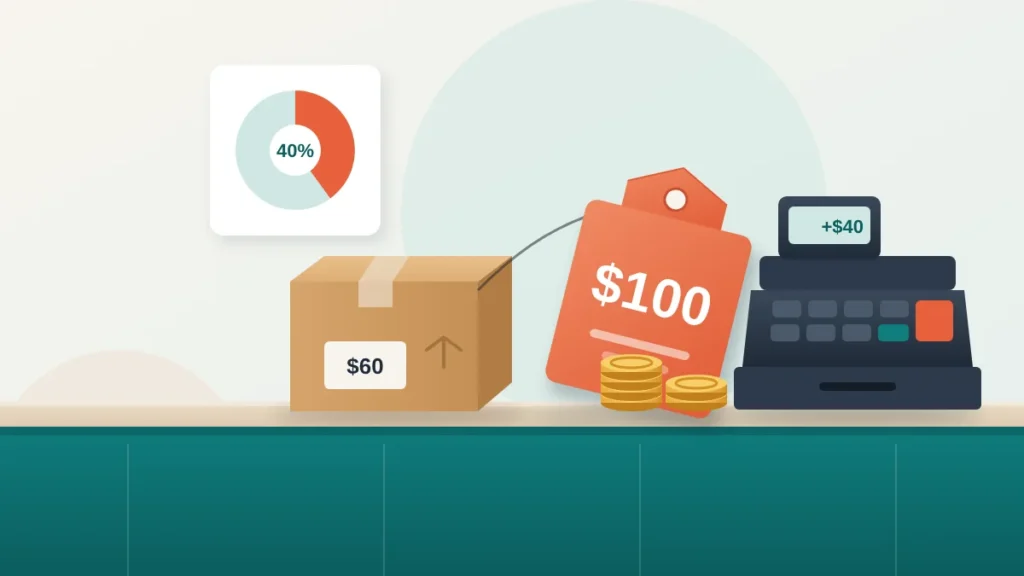
The difference between profit margin vs markup is the base you divide by. Markup is profit as a percentage of cost; margin is profit as a percentage of the selling price. An item that costs $60 and sells for $100 has a $40 profit, which is a 66.67% markup ($40 ÷ $60) but only a 40% margin ($40 ÷ $100).
Same item, same profit, two very different percentages. Mixing them up is one of the most common and expensive pricing errors in small business, because a price set with the wrong one can quietly cost you thousands. This guide gives you both formulas, shows how to convert between them, explains gross, operating and net margin, and walks through pricing examples. Our margin and markup calculator converts in either direction if you want to check as you go.
Profit margin vs markup: the formulas
Both start from the same profit figure, price minus cost.
Markup = (price − cost) ÷ cost × 100Margin = (price − cost) ÷ price × 100Because the price is always larger than the cost on a profitable sale, margin is always the smaller of the two numbers. Markup can go above 100% (selling at triple your cost is a 200% markup), but margin can never reach 100%, since that would mean the item cost you nothing.
Who uses which? Retailers and wholesalers often think in markup, because they start with a supplier invoice and add to it. Accountants, investors and lenders talk about margin, because financial statements are built around revenue. If you are doing both jobs in a small business, you need to be fluent in each.
Setting a price from either one
Rearrange the formulas and you can work out the price you need.
- From a markup:
price = cost × (1 + markup) - From a margin:
price = cost ÷ (1 − margin)
With a $50 cost and a 60% markup, the price is $50 × 1.60 = $80. The markup calculator gives the same answer and shows that $80 is a 37.5% margin. With a $60 cost and a 25% target margin, the price is $60 ÷ 0.75 = $80, which the margin calculator confirms is a 33.33% markup.
Converting between margin and markup
You do not need the cost or price to convert one percentage into the other. Write both as decimals and use:
Margin = markup ÷ (1 + markup)Markup = margin ÷ (1 − margin)A 50% markup is 0.5 ÷ 1.5 = 0.3333, or a 33.33% margin. A 40% margin is 0.4 ÷ 0.6 = 0.6667, or a 66.67% markup. Here are the pairs you will meet most often.
| Markup | Margin | Price on a $100 cost |
|---|---|---|
| 10% | 9.09% | $110 |
| 20% | 16.67% | $120 |
| 25% | 20.00% | $125 |
| 33.33% | 25.00% | $133.33 |
| 50% | 33.33% | $150 |
| 66.67% | 40.00% | $166.67 |
| 100% | 50.00% | $200 |
| 150% | 60.00% | $250 |
| 200% | 66.67% | $300 |
| 300% | 75.00% | $400 |
Notice how the gap widens as the numbers grow. At 10% the two are nearly equal; at 100% markup the margin is only half that. A 100% markup, doubling your cost, is known in retail as “keystone” pricing and gives a 50% margin.
Worked example: the markup-margin mix-up
Here is how the confusion plays out in real life. A coffee roaster buys a bag of green beans, roasts and packs it for a total cost of $45 per retail bag. The owner wants a 35% margin to cover rent, wages and some profit.
The wrong way. A new employee hears “35%” and adds 35% to the cost: $45 × 1.35 = $60.75. Margin on that price is ($60.75 − $45) ÷ $60.75 = 25.93%. The shop is almost 10 percentage points short of its target.
The right way. Divide by 1 minus the margin: $45 ÷ 0.65 = $69.23. Check: ($69.23 − $45) ÷ $69.23 = 35.0%.
The price gap is $8.48 per bag. Across 1,000 bags a year, that is $8,480 of gross profit that never shows up, and nobody notices until the year-end numbers come in. If you are fuzzy on the difference between percentage points and percent, our guide to calculating percentages explains why “35% vs 25.93%” is a gap of 9.07 points.
Gross vs operating vs net profit margin
So far we have talked about margin on a single product. When people quote a company’s “profit margin”, they could mean any of three numbers, each taking out more costs.
- Gross margin = (revenue − cost of goods sold) ÷ revenue. It shows how much each sale contributes after the direct cost of the product.
- Operating margin = (gross profit − operating expenses) ÷ revenue. It subtracts rent, salaries, marketing and other running costs.
- Net profit margin = net income ÷ revenue. It also takes out interest and taxes. This is the “bottom line”.
Take a business with $500,000 of revenue, $280,000 cost of goods sold, $120,000 of operating expenses, $10,000 of interest and $18,000 of taxes.
| Line | Amount | Margin |
|---|---|---|
| Revenue | $500,000 | 100% |
| Gross profit (after $280,000 COGS) | $220,000 | 44.0% |
| Operating profit (after $120,000 expenses) | $100,000 | 20.0% |
| Net profit (after $10,000 interest and $18,000 tax) | $72,000 | 14.4% |
The profit margin calculator produces all three from those inputs. If you only need one, the gross margin calculator and net profit margin calculator handle them individually. Getting cost of goods sold right is the foundation, and the COGS calculator works it out from opening inventory, purchases and closing inventory. The IRS describes how to figure cost of goods sold for a small business in Publication 334.
Markup only really applies at the product level. You will rarely see anyone quote an “operating markup”, which is another reason margins are the language of financial statements. The SEC’s Investor.gov site has a plain-English introduction to reading income statements if you want to compare your margins with public companies.
Pricing examples
Retail product with a target margin
You import a lamp for $30 landed cost and want a 40% gross margin. Price = $30 ÷ 0.60 = $50. Using a 40% markup instead would give $42, a 28.57% margin.
Service business using markup on materials
A contractor marks up materials by 20% and bills labor separately. On $2,500 of materials, the customer pays $3,000. The margin on materials is $500 ÷ $3,000 = 16.67%, which is useful to know when comparing the materials line with the labor line.
Markups stacked along a supply chain
Products usually pass through several hands, and each one adds its own markup. A manufacturer makes a candle for $8 and sells it to a retailer at a 50% markup, so the wholesale price is $12 and the manufacturer’s margin is 33.33%. The retailer then applies keystone pricing, a 100% markup, and puts it on the shelf at $24 with a 50% margin. The shopper pays three times the production cost, even though neither business took more than half of its own selling price as gross profit. Knowing both numbers helps you negotiate: a retailer asking for “50 points of margin” needs your wholesale price to be no more than half of the shelf price.
What a discount does to your margin
That $50 lamp has a $20 profit, a 40% margin. Run a 20% off sale and the price drops to $40, the profit falls to $10, and the margin is now 25%. You have halved the profit per lamp, so you need to sell twice as many just to earn the same gross profit. The margin with discount calculator shows how any discount eats into margin, and the break-even calculator tells you how many units you need to cover fixed costs at the new price.
Common pricing mistakes
- Applying a target margin as a markup. This always underprices. Divide by (1 − margin), do not multiply by (1 + margin).
- Leaving costs out of “cost”. Shipping, packaging, payment processing fees and returns all belong in the product’s cost before you calculate either figure.
- Comparing your markup with an industry margin. If a trade report says a typical gross margin is 50% and your markup is 50%, you are actually at 33.33%.
- Forgetting the effect of discounts. Small percentage discounts take a big bite out of thin margins.
- Treating gross margin as profit. A healthy 44% gross margin can still become a loss once rent and wages come out.
- Confusing margin with ROI. Margin compares profit with revenue; return on investment compares it with the money you put in. Our guide to calculating ROI explains the difference.
The U.S. Small Business Administration has a free business guide covering pricing, funding and managing finances, which is a good next step if you are setting prices for the first time. This guide is general information on the math, not personalized financial or accounting advice.
Frequently asked questions
Is a 50% markup the same as a 50% margin?
No. A 50% markup on a $100 cost gives a $150 price and a 33.33% margin. A 50% margin needs a 100% markup, so the price would be $200.
Which is better to use for pricing, margin or markup?
Either works if you are consistent. Many businesses set prices with a target margin because it ties directly to the income statement, then convert it to a markup for staff who price from the supplier cost.
Can margin be over 100%?
No. Margin is profit divided by price, and profit can never exceed the price unless the cost is negative. Markup has no upper limit.
How do I convert a markup to a margin quickly?
Divide the markup by 1 plus the markup, using decimals. A 25% markup is 0.25 ÷ 1.25 = 0.20, or a 20% margin.
What is a good profit margin?
It varies widely by industry. Grocery stores often run net margins of 1–3%, while software companies can exceed 20%. Compare yourself with businesses in your own sector rather than an across-the-board number.
Remember the one rule that matters: markup divides by cost, margin divides by price. Decide which one your business uses, write it down for everyone who sets prices, and convert with the formulas above whenever someone quotes the other. Then run your real costs through the calculators to make sure every price you set earns the margin you planned.