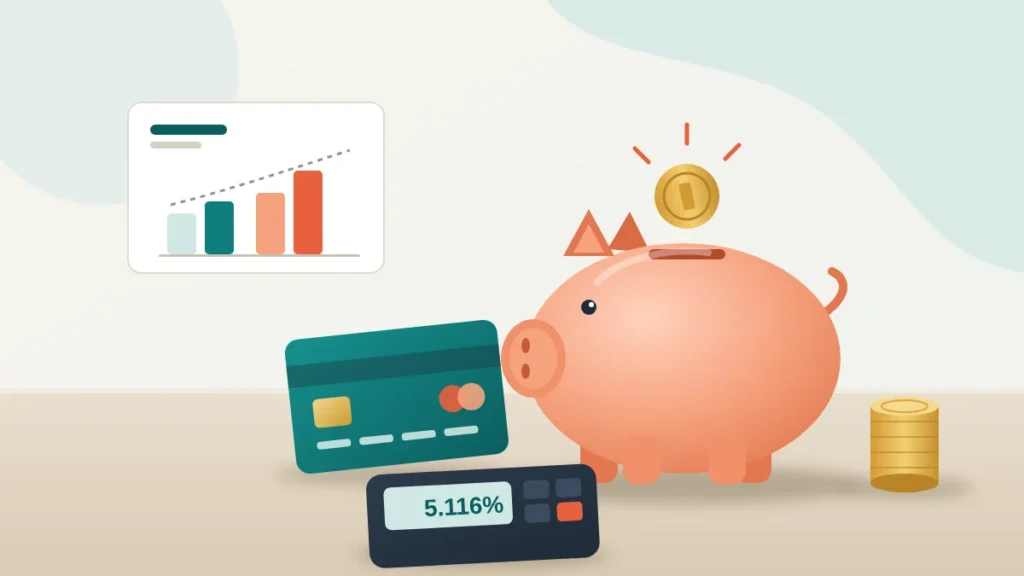
APR vs APY comes down to compounding. APR (annual percentage rate) is the yearly rate without compounding, and for loans it also includes certain fees. APY (annual percentage yield) includes the effect of compounding within the year. A 5% APR compounded monthly equals an APY of 5.116%, so the APY is always equal to or higher than the APR.
Banks use whichever figure looks better for them: APY on savings accounts, because it is the bigger number, and APR on loans and credit cards, because it is the smaller one. Once you know how to convert between the two, you can compare any savings offer or loan on equal terms. Our APR to APY calculator does the conversion instantly; this guide shows what is going on underneath.
What APR means
The annual percentage rate is the simple yearly rate. If a credit card has a 24% APR, the issuer divides that by 12 and charges 2% a month (or divides by 365 and charges about 0.0658% a day). Nothing in the APR figure itself reflects the fact that unpaid interest gets added to your balance and then charged interest too.
For loans, APR has a second job. Under the federal Truth in Lending Act, lenders must disclose an APR that includes the interest rate plus certain finance charges, such as origination fees, discount points and some closing costs. That makes the APR on a loan a measure of total borrowing cost, not just the rate. This is why your mortgage might have a 6.5% interest rate but a 6.68% APR.
What APY means
The annual percentage yield is what you actually earn (or pay) over a year once compounding is included. It answers a direct question: if I leave $10,000 here for a year, how much will I have? With a 4.5% APY, the answer is $10,450, no matter how often the bank compounds.
Federal Truth in Savings rules require banks and credit unions to show APY on deposit accounts, so you can compare a CD that compounds daily with a savings account that compounds monthly. APY usually does not include fees, though, so a monthly maintenance charge can eat into the real return.
APR vs APY: the key differences
| APR | APY | |
|---|---|---|
| Includes compounding | No | Yes |
| Includes fees | On loans, yes (certain finance charges) | No |
| Typically quoted for | Mortgages, car loans, personal loans, credit cards | Savings accounts, CDs, money market accounts |
| Relationship | Lower or equal | Higher or equal |
| Best used to | Compare the cost of loans | Compare what deposits earn |
One caution: the word “APR” means two slightly different things depending on context. On a savings account statement, APR might just be the nominal interest rate. On a loan disclosure, it is the nominal rate with fees built in. When you convert between APR and APY, you are working with the nominal-rate meaning.
How to convert APR to APY
The conversion formula is:
APY = (1 + APR ÷ n)^n − 1
Here n is the number of compounding periods per year: 12 for monthly, 365 for daily, 4 for quarterly. For continuous compounding, use APY = e^APR − 1.
Worked example: 5% APR compounded monthly
- Divide the rate: 0.05 ÷ 12 = 0.0041667.
- Add 1: 1.0041667.
- Raise to the 12th power: 1.0041667^12 = 1.05116.
- Subtract 1: 0.05116, or 5.116% APY.
The table shows how much compounding adds at different rates. The gap is tiny at savings-account rates and large at credit card rates.
| APR | Yearly | Quarterly | Monthly | Daily |
|---|---|---|---|---|
| 4% | 4.000% | 4.060% | 4.074% | 4.081% |
| 5% | 5.000% | 5.095% | 5.116% | 5.127% |
| 10% | 10.000% | 10.381% | 10.471% | 10.516% |
| 24% | 24.000% | 26.248% | 26.824% | 27.115% |
At 5%, daily compounding adds about 0.13 percentage points. At 24%, monthly compounding adds 2.82 points. That second number is why a credit card balance grows faster than its APR suggests: $3,000 left unpaid for a year at 24% APR compounded monthly becomes $3,804.73, not $3,720. The same principle is covered in more depth in our guide on how compound interest works.
How to convert APY to APR
Sometimes you need to go the other way, for example to compare a savings account quoted as APY with a rate quoted as a nominal figure. Rearrange the formula:
APR = n × [(1 + APY)^(1/n) − 1]
A 4.5% APY compounded monthly works out to 12 × (1.045^(1/12) − 1) = 4.410% APR. Compounded daily, it is 4.402%. The effective interest rate calculator handles both directions and any compounding frequency.
Why APR on a loan includes fees
Two loans with the same interest rate can cost very different amounts if one carries bigger fees. The loan APR exists to capture that. It is the rate that makes the money you actually receive equal to the present value of your payments.
Example: a personal loan with an origination fee
You borrow $20,000 for five years at a 10% interest rate. The lender charges a 5% origination fee, $1,000, taken out of the loan, so $19,000 lands in your account.
- Monthly payment on $20,000 at 10% for 60 months: $424.94.
- Total paid: $25,496.45, so $5,496.45 in interest plus the $1,000 fee.
- The APR is the rate at which $424.94 a month for 60 months is worth exactly $19,000 today: 12.24%.
So a loan advertised at 10% really costs 12.24% a year once the fee is counted. A competing loan at 11.5% with no fee would be cheaper, with a lower APR and a lower monthly payment on the $19,000 you need ($417.86). You can run your own offers through the APR calculator, which accepts both financed and upfront fees, or line several up in the loan comparison calculator.
Example: mortgage points and the holding period
Mortgage APRs assume you keep the loan for its full term, which few people do. Compare two offers on a $320,000, 30-year loan:
| Offer A | Offer B | |
|---|---|---|
| Interest rate | 6.25% | 6.75% |
| Points and fees | $8,000 | $1,000 |
| Monthly payment | $1,970.30 | $2,075.51 |
| APR (held 30 years) | 6.49% | 6.78% |
| Effective rate if sold after 3 years | 7.20% | 6.87% |
| Total cost after 3 years (interest + fees) | $66,942 | $64,758 |
Offer A wins on APR. But if you expect to sell or refinance within about four years, Offer B is cheaper because you never recover the extra $7,000 up front. Offer A only pulls ahead after about four and a half years (month 53). The mortgage rate calculator works out APR from your rate and fees, and our walk-through of how to calculate a mortgage payment explains where the monthly figures come from.
Where you will see each rate
- Savings and CDs: APY, by law. The FDIC publishes national average deposit rates you can benchmark against. Use the savings calculator to project growth from an APY.
- Credit cards: APR, usually several of them (purchase, balance transfer, cash advance, penalty). Interest typically compounds daily. The Federal Reserve’s G.19 consumer credit release reports average card rates if you want to see where yours sits.
- Mortgages and auto loans: both the interest rate and the APR appear on your Loan Estimate or disclosure; the CFPB’s home-buying tools show how to read one. Compare offers by APR, then sanity-check with your expected holding period.
- Personal loans: APR, which should include origination fees. Some lenders quote ranges; your actual APR depends on credit.
- Crypto and fintech accounts: often quote APY. Check whether the rate is variable, promotional or paid in a token rather than dollars.
Common mistakes with APR and APY
- Comparing an APR with an APY. A loan at 5% APR and a savings account at 5% APY are not the same rate. Convert one before comparing.
- Treating a card’s APR as the true yearly cost. With monthly compounding and a carried balance, 24% APR is 26.8% in practice. The credit card interest calculator shows the dollar figure.
- Ignoring fees on savings. APY excludes account fees. A $5 monthly fee on a $5,000 balance wipes out 1.2 percentage points of yield.
- Trusting APR for short holding periods. Points and fees are spread over the full term in the APR. Sell early and your real rate is higher.
- Forgetting variable rates. Both APR and APY can change on variable accounts. A promotional APY may last only a few months.
If you are carrying expensive debt while earning a modest APY on savings, the gap between those two numbers is money leaving your pocket every month. Paying off a 24% card beats almost any savings account; our guide to debt snowball vs avalanche covers how to prioritize. This article is general information, not personal financial advice.
Frequently asked questions
Is APY or APR better?
Neither is better; they measure different things. For savings, a higher APY is better for you. For borrowing, a lower APR is better, and it is the most useful single figure for comparing loan offers.
Why is APY higher than APR?
APY includes compounding, so interest earned during the year earns its own interest. The only time they are equal is when interest compounds once a year.
What is the APY of 5% APR compounded daily?
(1 + 0.05 ÷ 365)^365 − 1 = 5.127%. Compounded monthly it is 5.116%, and compounded continuously it is 5.127% as well when rounded to three decimals.
Is a credit card’s APR the same as its interest rate?
For credit cards, yes, the APR is the nominal interest rate, because cards rarely have finance fees built into the rate. The effective annual cost is higher because interest compounds, usually daily.
What is the difference between APY and interest rate?
The interest rate is the nominal yearly rate. APY converts it to what you actually earn in a year once compounding is included. A 4.40% interest rate compounded daily gives roughly a 4.50% APY.
Keep one rule in your head and the rest follows: APR is the rate before compounding, APY is the rate after. Look at APY when you save, APR when you borrow, and when the two meet in the same decision, convert one into the other before you compare. The compound interest calculator is a good place to see how each rate plays out over several years.