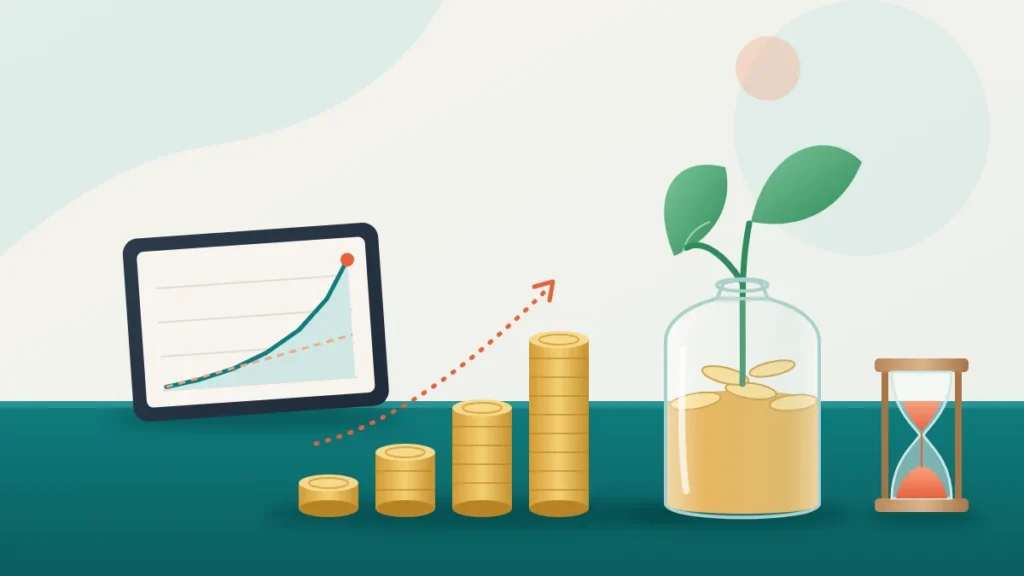
Compound interest does one simple thing: it adds the interest you earn to your balance, so the next round of interest is calculated on a bigger number. That is how it works: you earn interest on your interest. At 7% a year, $10,000 grows to $19,672 in 10 years, $38,697 in 20 years and $76,123 in 30 years without another deposit.
That is the short answer to how does compound interest work. The longer answer matters because the same mechanism decides how fast your savings grow, how much a fund fee really costs you and why credit card balances balloon. This guide walks through the formula, the effect of compounding frequency, the rule of 72, regular contributions and the debt side of the equation, with real numbers you can check in our compound interest calculator.
Simple interest vs compound interest
With simple interest, you earn a fixed percentage of the original amount every year and nothing more. $10,000 at 7% simple interest earns $700 a year, every year. After 30 years you have $31,000.
With compound interest, the $700 you earn in year one joins the balance. In year two you earn 7% of $10,700, which is $749. In year three it is 7% of $11,449, or $801. The yearly gain keeps rising, and after 30 years the same $10,000 has become $76,123, more than double the simple-interest result.
| Years | Simple interest at 7% | Compound interest at 7% (yearly) | Difference |
|---|---|---|---|
| 10 | $17,000 | $19,672 | $2,672 |
| 20 | $24,000 | $38,697 | $14,697 |
| 30 | $31,000 | $76,123 | $45,123 |
Notice how the gap is small at first and then widens fast. Compounding is slow in the early years and powerful in the late ones. That shape is the single most useful thing to understand about it. If you want to see the plain version side by side, the simple interest calculator gives the straight-line figure.
The compound interest formula
For a single deposit, the future value is:
A = P × (1 + r/n)^(n × t)
- A is the amount you end up with.
- P is the principal, what you start with.
- r is the annual interest rate as a decimal (5% = 0.05).
- n is how many times a year interest compounds: 1 for yearly, 4 for quarterly, 12 for monthly, 365 for daily.
- t is the number of years.
Worked example
You put $10,000 in an account paying 6% compounded monthly and leave it for 10 years.
- Rate per period: 0.06 ÷ 12 = 0.005.
- Number of periods: 12 × 10 = 120.
- Growth factor: 1.005^120 = 1.81940.
- Result: $10,000 × 1.81940 = $18,193.97.
You earned $8,193.97 in interest. With simple interest at 6%, you would have earned $6,000. The extra $2,194 is interest on interest. The same idea underlies the future value calculator, which also handles a series of payments.
How compounding frequency changes the result
The more often interest is added, the sooner it starts earning its own interest. Here is $10,000 at a 6% stated rate for 10 years:
| Compounding | Balance after 10 years | Effective annual yield |
|---|---|---|
| Yearly | $17,908.48 | 6.000% |
| Quarterly | $18,140.18 | 6.136% |
| Monthly | $18,193.97 | 6.168% |
| Daily | $18,220.29 | 6.183% |
| Continuous | $18,221.19 | 6.184% |
Going from yearly to monthly is worth about $285 here. Going from monthly to daily adds only $26, and continuous compounding (the mathematical limit, A = Pe^(rt)) adds less than a dollar more. Our continuous compound interest calculator shows the limit if you are curious.
The third column is the annual percentage yield, or APY. Banks have to quote savings accounts by APY under the Truth in Savings rules, precisely so you can compare accounts that compound differently. The APR to APY calculator converts between the two, and our guide to APR vs APY explains why loans and savings accounts are quoted differently. The practical takeaway: when comparing savings accounts, compare APYs and ignore how often they compound.
The rule of 72
You do not need a calculator to estimate how long money takes to double. Divide 72 by the annual rate in percent. At 6%, money doubles in about 72 ÷ 6 = 12 years. At 9%, about 8 years.
| Annual rate | Rule of 72 estimate | Exact doubling time |
|---|---|---|
| 3% | 24.0 years | 23.4 years |
| 4% | 18.0 years | 17.7 years |
| 6% | 12.0 years | 11.9 years |
| 8% | 9.0 years | 9.0 years |
| 10% | 7.2 years | 7.3 years |
| 12% | 6.0 years | 6.1 years |
The rule is most accurate between about 6% and 10%. The exact formula is years = ln 2 ÷ ln(1 + r), and the rule of 72 calculator compares both. It also works in reverse and for anything that grows by a percentage: at 3% inflation, prices double in roughly 24 years, which is why the inflation calculator is worth a look when you plan for retirement.
Adding regular contributions
Most people do not invest one lump sum and walk away. They add money every month. The formula for a stream of equal monthly deposits is:
FV = PMT × [(1 + i)^N − 1] ÷ i
Here PMT is the monthly deposit, i is the monthly rate and N is the number of months. Put $300 a month into an investment that returns 7% a year, compounded monthly:
| Years | Total deposited | Balance | Growth from compounding |
|---|---|---|---|
| 10 | $36,000 | $51,925 | $15,925 |
| 20 | $72,000 | $156,278 | $84,278 |
| 30 | $108,000 | $365,991 | $257,991 |
By year 30, growth makes up 70% of the balance. Even a modest savings habit adds up: $200 a month at 5% for 30 years becomes about $166,452, of which roughly $94,450 is interest.
Why starting early matters so much
Compare two savers who both invest $300 a month at 7% until age 65. One starts at 25 and contributes for 40 years, $144,000 in total. The other starts at 35 and contributes for 30 years, $108,000 in total. The early starter ends with about $787,444. The later starter ends with $365,991. Ten extra years of deposits, worth $36,000, more than doubled the final pot.
Now take a third saver who invests $300 a month from 25 to 35 and then stops completely. They put in only $36,000. By 65 that money has grown to about $421,453, more than the person who saved for 30 years starting at 35. Time does the heavy lifting. Our investment calculator lets you try your own start dates and returns. Real investment returns go up and down, of course; a steady 7% is a planning assumption, not a promise, and this guide is general information rather than personal financial advice.
Compound interest on debt
Compounding works exactly the same way when you are the borrower. The difference is that it now works against you, and consumer debt rates are usually much higher than savings rates.
A credit card with a 22.99% APR charges about 1.92% a month on your balance. Leave $5,000 untouched for a year and it grows to $6,279, an effective rate of 25.57%. Pay $150 a month and it takes 54 months to clear, with $3,045 in interest. Raise the payment to $250 and you are done in 26 months, paying $1,366 in interest. That is $1,679 saved by adding $100 a month. You can test your own card in the credit card interest calculator.
The Consumer Financial Protection Bureau’s credit card resources explain how card interest, grace periods and minimum payments work. If you have several debts, the order you pay them in changes how much compound interest you pay overall; our guide on debt snowball vs avalanche runs the numbers. Mortgages compound too, which is why the interest on a 30-year home loan can exceed the amount borrowed, as shown in how to calculate a mortgage payment.
Quick tips for making compounding work for you
- Start now, even small. Ten years of growth is worth more than a slightly bigger deposit later.
- Reinvest the returns. Dividends and interest you withdraw stop compounding. Turn on automatic reinvestment where you can.
- Watch fees. A 1% yearly fee compounds too. On $300 a month for 30 years, the difference between 7% and 6% net returns is about $64,637. The investment fee calculator shows the drag on your own portfolio.
- Compare APY, not the headline rate, when choosing a savings account or CD. The FDIC publishes national average deposit rates you can use as a benchmark.
- Kill high-rate debt first. Paying off a 23% card is a guaranteed 23% return, which no savings account will match.
- Think in real terms. A 4% return with 3% inflation grows your purchasing power by only about 1% a year.
Frequently asked questions
How does compound interest work in a savings account?
The bank calculates interest on your balance, usually daily, and adds it to the account monthly. From then on that interest earns interest too. The APY shown by the bank already includes this effect over a year.
How often is interest compounded?
Savings accounts usually compound daily or monthly, CDs daily, monthly or quarterly, and bonds often semi-annually. Credit cards in the US typically compound daily on the average daily balance.
How much will $10,000 grow in 10 years?
At 5% compounded monthly, $10,000 becomes about $16,470 in 10 years. At 7% it becomes about $20,097, and at 3% about $13,494.
Is compound interest calculated daily or monthly?
It depends on the account terms. The difference between daily and monthly compounding is small, about $26 on $10,000 at 6% over 10 years, so the stated APY is the figure that matters.
What is the difference between compound interest and CAGR?
Compound interest describes how a fixed rate grows money over time. CAGR, the compound annual growth rate (see our CAGR calculator), works backwards from a start and end value to find the steady yearly rate that would connect them, which is useful for investments with uneven returns.
Compound interest is not complicated, but it is easy to underestimate because the early years look so unimpressive. Once you see the 30-year numbers, the strategy writes itself: save early, keep fees low, reinvest everything and clear expensive debt before it compounds against you. The SEC’s Investor.gov site has further free tools if you want a second opinion on your plan.