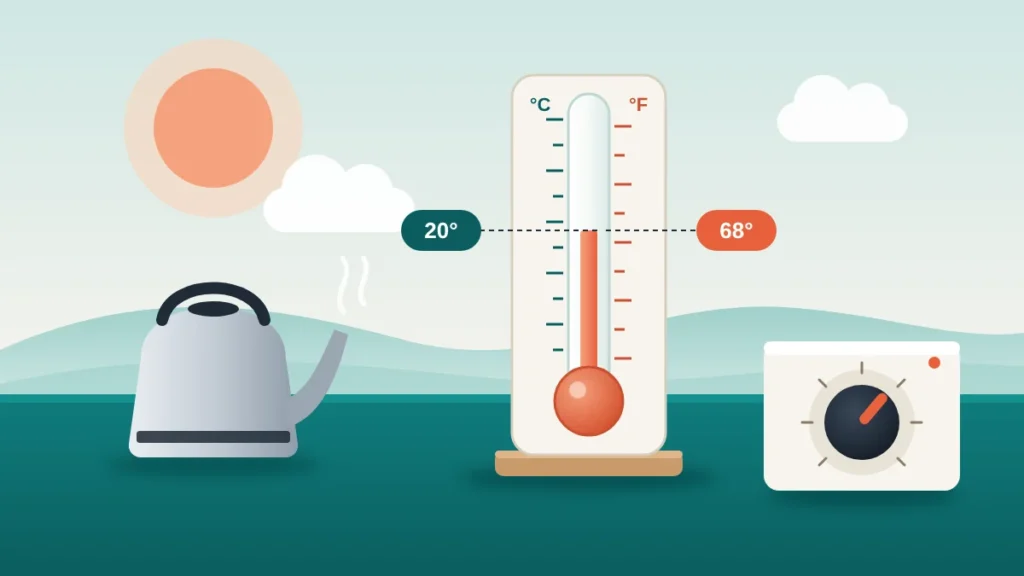
To convert Celsius to Fahrenheit, multiply the Celsius temperature by 9/5 (1.8) and add 32: °F = °C × 1.8 + 32. So 20 °C is 20 × 1.8 + 32 = 68 °F, and 100 °C is 212 °F. To go back, subtract 32 and divide by 1.8.
Our Celsius to Fahrenheit converter gives you the exact answer as you type, but it is worth knowing the formula, why it has two steps, and which mental shortcuts are safe. The popular “double it and add 30” trick is close for weather and badly wrong for ovens. Below you will find the exact math, a table of temperatures people actually look up, and how kelvin fits in.
The Celsius to Fahrenheit formula, explained
°F = (°C × 9/5) + 32
The two scales differ in two ways, so the conversion needs two operations.
- Different degree sizes. Water freezes at 0 °C and boils at 100 °C, a gap of 100 Celsius degrees. On the Fahrenheit scale the same points are 32 °F and 212 °F, a gap of 180 degrees. So one Celsius degree equals 180 ÷ 100 = 1.8 Fahrenheit degrees. That is the multiply step.
- Different zero points. Zero Celsius sits at 32 on the Fahrenheit scale. After scaling, you shift by 32. That is the add step.
The order matters. Multiply first, then add. If you add 32 to 20 °C first and then multiply, you get 93.6 °F instead of 68 °F.
Where the two scales came from
Daniel Gabriel Fahrenheit built his scale in the 1720s around reference points he could reproduce in his workshop: a freezing brine mixture for zero and human body temperature near the top. Water happened to land at 32 and 212. Anders Celsius proposed his centigrade scale in 1742 with 100 steps between freezing and boiling water (originally upside down, with boiling at zero). Today both are defined from the kelvin, which is why the conversion factors are exact numbers rather than measurements.
Worked examples
- A warm afternoon, 28 °C: 28 × 1.8 = 50.4, plus 32 = 82.4 °F.
- Body temperature, 37 °C: 37 × 1.8 = 66.6, plus 32 = 98.6 °F.
- A cold morning, −5 °C: −5 × 1.8 = −9, plus 32 = 23 °F. Negative numbers follow the same rule; just keep track of the sign.
- A baking recipe, 180 °C: 180 × 1.8 = 324, plus 32 = 356 °F. Most American recipes would round that to 350 °F.
Fahrenheit to Celsius: the reverse formula
°C = (°F − 32) × 5/9
Here the order flips: subtract first, then divide by 1.8 (or multiply by 5/9). A thermostat set to 72 °F is (72 − 32) ÷ 1.8 = 40 ÷ 1.8 = 22.2 °C. A 350 °F oven is 318 ÷ 1.8 = 176.7 °C. Use the Fahrenheit to Celsius converter when you are reading an American recipe or weather report.
One number is the same on both scales: −40. Plug it in and check: −40 × 1.8 + 32 = −72 + 32 = −40. It is a handy sanity check for any conversion you do by hand.
Mental shortcuts and how wrong they are
When you are standing in a hotel room abroad looking at a forecast, nobody wants to multiply by 1.8. Here are the three shortcuts worth knowing.
1. Double and add 30 (fast, approximate)
Double the Celsius figure and add 30. 20 °C becomes 70 °F (exact: 68 °F). The error is 0.2 × °C − 2, so it is perfect at 10 °C, off by 2–4 °F across normal weather, and grows steadily as temperatures climb. At 200 °C, an oven setting, it says 430 °F when the truth is 392 °F, a 38-degree miss that will burn cookies.
2. Double, subtract 10%, add 32 (exact)
This is the formula in disguise, because doubling and taking off a tenth is the same as multiplying by 1.8. For 30 °C: double is 60, minus 10% (6) is 54, plus 32 is 86 °F, which is exactly right. It takes a few seconds longer and never misleads you.
3. Memorize the anchor points
A short rhyme some people use: “30 is hot, 20 is nice, 10 is cool, zero is ice.” Add the matching Fahrenheit numbers, 86, 68, 50 and 32, and you can interpolate almost any weather forecast in your head. Every 5 °C step is a 9 °F step.
| °C | Exact °F | “Double + 30” says | Error (°F) |
|---|---|---|---|
| −10 | 14 | 10 | −4 |
| 0 | 32 | 30 | −2 |
| 10 | 50 | 50 | 0 |
| 20 | 68 | 70 | +2 |
| 30 | 86 | 90 | +4 |
| 40 | 104 | 110 | +6 |
| 100 | 212 | 230 | +18 |
| 200 | 392 | 430 | +38 |
As a percentage the shortcut stays within a few percent for weather but drifts to almost 10% at oven temperatures. If you want to quantify that kind of gap yourself, our guide on percent error vs percent difference shows the formula.
Celsius to Fahrenheit reference table
These are the conversions people search for most often, grouped by where you meet them.
| Situation | °C | °F |
|---|---|---|
| Celsius and Fahrenheit are equal | −40 | −40 |
| Freezer | −18 | 0 (−0.4) |
| Water freezes | 0 | 32 |
| Refrigerator | 4 | 39.2 |
| Cool spring day | 15 | 59 |
| Comfortable room | 20–22 | 68–71.6 |
| Warm summer day | 25 | 77 |
| Hot day | 35 | 95 |
| Normal body temperature | 37 | 98.6 |
| Fever threshold | 38 | 100.4 |
| Water boils (sea level) | 100 | 212 |
| Slow oven | 150 | 302 |
| Moderate oven | 180 | 356 (recipes: 350) |
| Hot oven | 200 | 392 (recipes: 400) |
| Very hot oven | 220 | 428 (recipes: 425) |
If you need any other value, or several units at once, the temperature converter shows Celsius, Fahrenheit, kelvin and Rankine side by side.
Where kelvin fits in
Kelvin is the SI base unit of temperature and the one scientists use. It has the same degree size as Celsius but starts at absolute zero, the coldest possible temperature, so there are no negative values. The National Institute of Standards and Technology defines the relationship exactly:
- K = °C + 273.15
- °F = K × 1.8 − 459.67
- Absolute zero = 0 K = −273.15 °C = −459.67 °F
Note that kelvin is written without a degree sign: 300 K, not 300 °K. A room at 20 °C is 293.15 K and 68 °F. For quick lab conversions, the kelvin to Fahrenheit converter handles the two-step math. Rankine, used in some US engineering, is to Fahrenheit what kelvin is to Celsius: same degree size, zero at absolute zero, so °R = °F + 459.67.
Converting temperature changes (not temperatures)
This catches out even careful people. When a forecast says tomorrow will be 10 °C warmer, the change in Fahrenheit is 10 × 1.8 = 18 °F, not 50 °F. The +32 only applies to a point on the scale, not to a difference between two points, because the offset cancels out when you subtract.
The same applies to climate figures. A global temperature rise of 1.5 °C is 2.7 °F. A recipe that says “reduce the oven by 20 °C for a fan oven” means about 36 °F lower, which is close to the 25 °F reduction that American guides recommend for convection ovens.
Cooking, weather and health uses
In the kitchen
Oven dials in the US go up in 25 °F steps and recipes round to them, so 180 °C becomes 350 °F, 190 °C becomes 375 °F and 220 °C becomes 425 °F. Meat thermometers are a different matter: food safety targets should be converted exactly. The FoodSafety.gov safe minimum internal temperature chart lists 165 °F (73.9 °C) for poultry and 145 °F (62.8 °C) for whole cuts of beef, pork and lamb with a rest. If you are converting an oven recipe for an air fryer, the air fryer conversion calculator drops the temperature and time for you, and our cups to grams guide covers the other half of recipe conversion.
Weather
Air temperature alone does not tell you how a day feels. On humid days the heat index calculator shows the “feels like” temperature, and on cold, windy days the wind chill calculator does the same. The National Weather Service publishes both in Fahrenheit for the US.
Body temperature
Thermometers sold outside the US read in Celsius. Normal is roughly 36.1–37.2 °C (97–99 °F), and a reading of 38 °C (100.4 °F) or higher is the common definition of a fever. This is general information, not medical advice; follow your doctor’s guidance on when a temperature needs attention.
Common mistakes
- Adding 32 before multiplying, instead of after.
- Applying +32 to a temperature difference (10 °C warmer is 18 °F warmer).
- Using “double and add 30” for oven or candy temperatures, where it overshoots by 30–50 °F.
- Dividing by 9/5 instead of multiplying when going from Celsius to Fahrenheit.
- Writing “degrees kelvin” or °K; it is simply kelvin (K).
- Rounding a food-safety temperature the way you would round an oven setting.
Frequently asked questions
What is the easiest way to convert Celsius to Fahrenheit?
For a close estimate, double the Celsius number and add 30. For an exact answer in your head, double it, subtract 10% of that, then add 32.
Is 25 °C hot or cold?
25 °C is 77 °F, a warm, pleasant day. Shorts weather for most people, but not uncomfortably hot.
Why does the US still use Fahrenheit?
The US adopted Fahrenheit in colonial times and never completed a switch to metric for everyday use. Science, medicine and most other countries use Celsius, which is why the conversion comes up so often.
At what temperature are Celsius and Fahrenheit the same?
At −40 degrees. Setting °F equal to °C in the formula gives C = 1.8C + 32, which solves to C = −40.
How do I convert 350 °F to Celsius for my oven?
(350 − 32) ÷ 1.8 = 176.7 °C, which European ovens round to 180 °C. For a fan (convection) oven, set about 160 °C.
Most of the time you only need two things: multiply by 1.8 and add 32, and remember that differences skip the +32. Keep a few anchor temperatures in your head for travel and weather, convert food-safety numbers exactly, and use the converter when the number really matters, such as a recipe, a lab reading or a child’s thermometer.