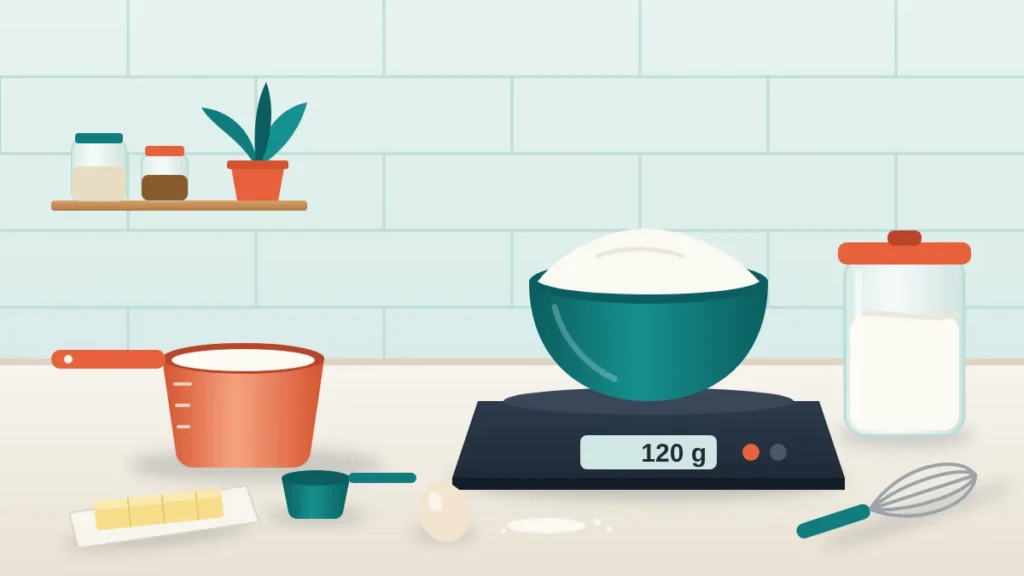
There is no single cups to grams conversion, because a cup measures volume and a gram measures weight. Each ingredient packs differently: one US cup of all-purpose flour weighs about 120 g, granulated sugar 198 g, butter 227 g and water 237 g. Multiply the number of cups by the grams per cup for that specific ingredient.
That is the answer in one line. The rest of this guide gives you the numbers for the ingredients you actually bake with, explains why your cup of flour might weigh 145 g instead of 120, and walks through a full recipe conversion. For anything not in the charts, the cups to grams converter covers more than 50 ingredients and all four common cup sizes.
Why cups to grams depends on the ingredient
A cup is a fixed volume: 236.6 ml in the US. What fits into that space varies a lot. Flour is fluffy and full of air, so a cup of it is light. Sugar crystals pack tightly, so the same cup holds more. Honey is denser than water, so a cup of honey weighs about 336 g.
The general formula is:
grams = cups × grams per cup for that ingredient
or, if you know the density, grams = cups × cup volume in ml × density in g/ml. Water has a density of almost exactly 1 g/ml, which is why a cup of water is about 237 g and why milk, at about 1.03 g/ml, comes in a touch heavier at 242 g. For liquids, the ml to grams calculator does this directly from a measured volume.
Weight is the more reliable measure. A gram of flour is a gram of flour whether it was sifted, scooped or packed. That consistency is why professional bakers, and most recipes outside the US, use a scale. NIST’s culinary measurement tips make the same point about accuracy at home.
Cups to grams chart for common baking ingredients
All figures are for a US cup (236.6 ml), with dry ingredients spooned into the cup and leveled. They match the values used by our converter and are close to the widely used King Arthur Baking ingredient weight chart. Rounded to the nearest gram.
| Ingredient | 1 cup | ¾ cup | ½ cup | ⅓ cup | ¼ cup |
|---|---|---|---|---|---|
| All-purpose flour | 120 g | 90 g | 60 g | 40 g | 30 g |
| Bread flour | 120 g | 90 g | 60 g | 40 g | 30 g |
| Whole wheat flour | 113 g | 85 g | 56 g | 38 g | 28 g |
| Cake flour | 120 g | 90 g | 60 g | 40 g | 30 g |
| Almond flour | 96 g | 72 g | 48 g | 32 g | 24 g |
| Cocoa powder | 84 g | 63 g | 42 g | 28 g | 21 g |
| Granulated sugar | 198 g | 148 g | 99 g | 66 g | 50 g |
| Brown sugar (packed) | 213 g | 160 g | 106 g | 71 g | 53 g |
| Powdered sugar | 113 g | 85 g | 56 g | 38 g | 28 g |
| Butter | 227 g | 170 g | 114 g | 76 g | 57 g |
| Vegetable oil | 198 g | 148 g | 99 g | 66 g | 50 g |
| Honey | 336 g | 252 g | 168 g | 112 g | 84 g |
| Water | 237 g | 177 g | 118 g | 79 g | 59 g |
| Milk | 242 g | 182 g | 121 g | 81 g | 60 g |
| Heavy cream | 238 g | 178 g | 119 g | 79 g | 60 g |
| Rolled oats | 89 g | 67 g | 44 g | 30 g | 22 g |
| Chocolate chips | 170 g | 128 g | 85 g | 57 g | 42 g |
| Peanut butter | 270 g | 202 g | 135 g | 90 g | 68 g |
A few patterns are worth remembering. Most white flours land at 120 g per cup, sugar is about 200 g, and butter and most dairy are close to the weight of water. Powdered sugar is much lighter than granulated because the fine powder traps air, about 113 g versus 198 g.
Flour: spooning versus scooping
Flour causes more conversion trouble than everything else combined. The 120 g figure assumes the “spoon and level” method:
- Stir or fluff the flour in its bag or bin.
- Spoon it into the measuring cup until it mounds over the top.
- Sweep the excess off with the back of a knife.
If you instead dip the cup into the bag and scoop, you compress the flour. That cup can weigh 140 to 150 g, up to 25% more than the recipe expects. Across 3 cups of flour, scooping can add 60 to 90 g, roughly another half cup. Dry cookies, dense cakes and stiff bread dough are the usual results.
Sifted flour goes the other way: a cup of flour sifted directly into the measure can weigh as little as 100 to 110 g. When a recipe says “1 cup sifted flour”, sift first and then measure. When it says “1 cup flour, sifted”, measure first and then sift.
Sugar, butter and liquids
Sugar
Granulated sugar is forgiving: it flows into the cup consistently, so 198 g (often rounded to 200 g) is reliable. Brown sugar is the exception, because recipes almost always mean “packed”. Press it firmly into the cup until it holds its shape when turned out; that gives about 213 g. Loosely spooned brown sugar can be 150 g or less.
Butter
One cup of butter is 227 g, which is two US sticks of 113.4 g each. The wrappers are marked in tablespoons, so you rarely need to pack butter into a cup. The butter calculator converts between sticks, cups, tablespoons and grams, and the oil to butter calculator helps if you are swapping fats.
Liquids
Liquids are the easiest conversion because their density is close to water. Water is 237 g per cup, milk and buttermilk about 242 g, heavy cream about 238 g and vegetable oil only 198 g, since oil is less dense than water. Syrups are the heavy ones: honey 336 g and maple syrup 312 g per cup. A tip for sticky liquids: weigh them straight into the bowl on a scale and you never have to scrape out a measuring cup.
US, metric and imperial cups are not the same
A “cup” is a different size depending on where the recipe was written:
| Cup type | Volume | All-purpose flour | Granulated sugar | Water |
|---|---|---|---|---|
| US customary cup | 236.6 ml | 120 g | 198 g | 237 g |
| US legal cup (nutrition labels) | 240 ml | 122 g | 201 g | 240 g |
| Metric cup (Australia, NZ, Canada, UK modern) | 250 ml | 127 g | 209 g | 250 g |
| Imperial cup (older UK recipes) | 284 ml | 144 g | 238 g | 284 g |
The difference between US and metric cups is about 6%, small enough that most cake and cookie recipes still work. The imperial cup is 20% bigger than the US cup, which is enough to wreck a recipe. If an old British cookbook gives cups, it probably means imperial. Our cooking measurement converter handles cups, spoons, ounces and millilitres across these systems.
This sort of “same name, different size” problem turns up outside the kitchen too. It is the same reason a 1 TB hard drive shows as 931 GB in Windows, which our guide on why a 1TB drive shows 931GB explains.
Worked example: converting a cookie recipe to grams
Here is a classic chocolate chip cookie recipe in cups, converted using the chart:
| Ingredient | Volume | Calculation | Grams |
|---|---|---|---|
| All-purpose flour | 2¼ cups | 2.25 × 120 | 270 g |
| Butter | 1 cup | 1 × 227 | 227 g |
| Granulated sugar | ¾ cup | 0.75 × 198 | 149 g |
| Brown sugar, packed | ¾ cup | 0.75 × 213 | 160 g |
| Chocolate chips | 2 cups | 2 × 170 | 340 g |
| Baking soda | 1 tsp | 288 ÷ 48 | 6 g |
The baking soda line uses the fact that there are 48 teaspoons in a cup: 288 g per cup ÷ 48 = 6 g per teaspoon. For small amounts like this it is often easier to keep using spoons, or to use the teaspoons to grams converter, since many kitchen scales only read in whole grams.
Once the recipe is in grams, scaling it is simple arithmetic. Want a batch and a half? Multiply every weight by 1.5: 405 g flour, 341 g butter and so on. The recipe scaler does the whole list at once, and our guide on how to calculate percentage helps if you want to adjust by a percentage instead.
Going the other way: grams to cups
If you have a European or professional recipe and only measuring cups, divide instead of multiply:
cups = grams ÷ grams per cup
500 g of all-purpose flour is 500 ÷ 120 = 4.17 cups, so 4 cups plus about 2⅔ tablespoons. 500 g of sugar is 500 ÷ 198 = 2.53 cups, about 2½ cups. The grams to cups converter does the division and rounds to practical fractions.
Quick tips for accurate baking
- Buy a digital scale. One that reads in 1 g steps and has a tare button costs less than a set of good measuring cups and removes almost all guesswork.
- Use the tare button. Put the bowl on, zero it, add flour; zero again, add sugar. One bowl, no cups to wash.
- Measure small amounts by volume. Salt, baking powder and yeast under 5 g are easier with measuring spoons unless you have a jeweler’s scale.
- Check the cup in the recipe. US, metric or imperial changes the answer by up to 20%.
- Note the ingredient precisely. Kosher salt and table salt differ hugely by volume: about 135 g per cup for Diamond Crystal kosher salt versus 288 g for table salt.
- Use nutrition data wisely. If you are tracking calories, label serving sizes are in grams for a reason; USDA FoodData Central lists most ingredients per 100 g.
Frequently asked questions
How many grams are in 1 cup of flour?
About 120 g of all-purpose flour, spooned and leveled in a US cup. Scooped straight from the bag it can be 140 to 150 g.
How many grams are in 1 cup of sugar?
About 198 g of granulated sugar, often rounded to 200 g. Packed brown sugar is about 213 g and powdered sugar about 113 g.
How many grams are in 1 cup of butter?
227 g, which is two US sticks. Half a cup, or one stick, is 113 g.
Is 1 cup always 250 grams?
No. A metric cup holds 250 ml, which is 250 g only for water. A metric cup of flour weighs about 127 g and of sugar about 209 g.
How many grams is a cup of milk?
About 242 g per US cup. Milk is slightly denser than water, so it weighs a little more than its volume in millilitres.
Use the chart for everyday baking, spoon and level your flour when you must use cups, and switch to a scale whenever you can. Once you have weighed a recipe once and written the grams in the margin, you will get the same cake every time you bake it.