To work out how many calories you should eat, start with your basal metabolic rate (BMR) from the Mifflin–St Jeor equation, multiply it by an activity factor to get your total daily energy expenditure (TDEE), then subtract about 500 calories a day to lose roughly 1 lb (0.45 kg) a week, or add 250 to 500 to gain.
That range is wide because you are not average. A 5 ft 4 in office worker and a 6 ft 2 in builder need very different amounts of food. The quickest way to get your own number is the calorie calculator, which does the whole sequence for you. This guide shows what happens inside it, works through a full example, and explains why your first number is a starting estimate you will adjust after a few weeks.
Step 1: Work out your BMR
Your BMR is the energy your body burns at complete rest: keeping your heart beating, your brain running, your temperature steady. For most people it makes up 60 to 70% of the calories burned in a day.
The Mifflin–St Jeor equation is the one the Academy of Nutrition and Dietetics recommends, because it predicts measured BMR more accurately than older formulas for most adults:
- Men: BMR = 10 × weight (kg) + 6.25 × height (cm) − 5 × age + 5
- Women: BMR = 10 × weight (kg) + 6.25 × height (cm) − 5 × age − 161
If you use pounds and inches, convert first: kg = lb ÷ 2.2046 and cm = in × 2.54. The BMR calculator accepts either.
Two other equations are worth knowing. The revised Harris–Benedict formula, available in the Harris–Benedict calculator, tends to come out 50 to 100 calories higher. The Katch–McArdle formula (370 + 21.6 × lean body mass in kg) uses your lean mass instead of total weight, so it is the better choice if you know your body fat percentage and are either very lean or carry a lot of fat. If you do not know yours, the guide on BMI vs body fat percentage explains how to estimate it with a tape measure.
Step 2: Multiply by your activity level to get TDEE
BMR covers rest only. Your total daily energy expenditure adds the calories from exercise, everyday movement (walking, standing, fidgeting, chores) and digesting food. You estimate it by multiplying BMR by an activity factor:
| Activity level | Typical week | Multiplier |
|---|---|---|
| Sedentary | Desk job, little or no exercise | 1.2 |
| Light | Exercise 1 to 3 times a week | 1.375 |
| Moderate | Exercise 4 to 5 times a week | 1.465 |
| Active | Daily exercise or intense exercise 3 to 4 times a week | 1.55 |
| Very active | Intense exercise 6 to 7 times a week | 1.725 |
| Extra active | Very intense daily exercise or a physical job | 1.9 |
The TDEE calculator shows your number at every level side by side, which is handy because most people overrate their activity. A one-hour gym session four times a week is “moderate”, not “very active”, if you sit for the other 23 hours. When in doubt, pick the lower level. It is easier to add food later than to wonder why nothing is changing.
A worked example: how many calories should I eat to lose weight?
Take a 35-year-old woman who is 165 cm (5 ft 5 in) tall, weighs 70 kg (154 lb) and does a mix of running and strength training four times a week.
- BMR: 10 × 70 + 6.25 × 165 − 5 × 35 − 161 = 700 + 1,031.25 − 175 − 161 = 1,395 kcal.
- TDEE: 1,395 × 1.465 (moderate) = 2,044 kcal. That is her estimated maintenance level, the intake that keeps her weight stable.
- Goal: she wants to lose 0.5 kg (1.1 lb) a week. Using about 7,700 kcal per kg of body fat, that needs a deficit of 0.5 × 7,700 ÷ 7 = 550 kcal a day.
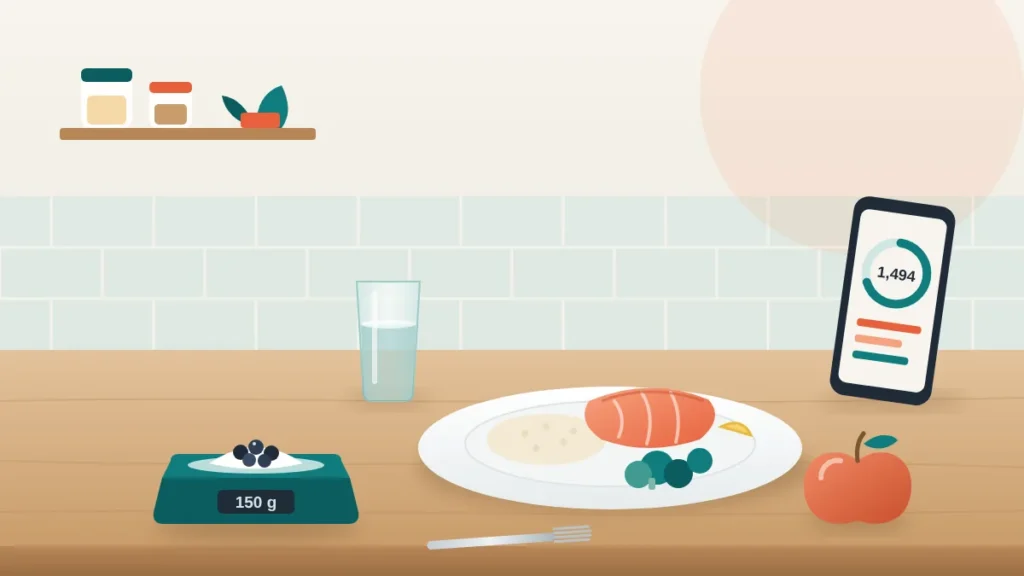
- Target: 2,044 − 550 = 1,494 kcal a day.
Here is how her maintenance calories change with activity level, which shows why the multiplier matters so much:
| Activity level | Maintenance (kcal/day) | To lose 0.5 kg/week | To lose 0.25 kg/week |
|---|---|---|---|
| Sedentary (1.2) | 1,674 | 1,124 | 1,399 |
| Light (1.375) | 1,918 | 1,368 | 1,643 |
| Moderate (1.465) | 2,044 | 1,494 | 1,769 |
| Active (1.55) | 2,163 | 1,613 | 1,888 |
| Very active (1.725) | 2,407 | 1,857 | 2,132 |
If she were sedentary, a 0.5 kg weekly loss would push her to 1,124 kcal, below the level most dietitians recommend without supervision. The smarter move there is a slower 0.25 kg a week at about 1,400 kcal, or adding activity. The calorie deficit calculator flags targets like that and tells you how many weeks your goal will take.
For comparison, a 30-year-old man who is 178 cm (5 ft 10 in) and 75 kg (165 lb) with the same moderate activity has a BMR of 1,718 kcal and a TDEE of about 2,516 kcal.
How big should your deficit or surplus be?
A safe rate of loss for most people is 0.5 to 1% of body weight a week. For our 70 kg example, 0.5 kg a week is 0.7%, right in the sweet spot. Faster than 1% tends to cost muscle, energy and adherence.
- Mild loss: 250 to 300 kcal below maintenance. Good if you are already fairly lean or want to keep training hard.
- Standard loss: 500 to 550 kcal below maintenance, about 0.5 kg (1 lb) a week.
- Aggressive loss: 750 to 1,000 kcal below maintenance. Only sensible for people with a lot of weight to lose, and ideally with medical support.
- Lean gain: 250 to 500 kcal above maintenance, aiming for 0.25 to 0.5% of body weight a week. The weight gain calculator sets this up.
As a floor, most guidance suggests not going below about 1,200 kcal a day for women or 1,500 for men without a doctor or dietitian involved. Below that it gets very hard to meet your needs for protein, vitamins and minerals. This is general information, not personal medical advice, so if you have a health condition, are pregnant or have a history of disordered eating, work with a professional on your numbers.
Protein and macros: what to eat within your calories
Calories decide whether you gain or lose weight. Protein largely decides whether that weight is fat or muscle. The RDA is 0.8 g per kg of body weight, but that is a minimum for sedentary adults. If you are dieting or lifting, 1.6 to 2.2 g/kg protects muscle much better. The protein intake calculator gives a figure for your goal and splits it across meals.
For our example woman at 1,494 kcal:
- Protein: 1.6 g × 70 kg = 112 g, which is 448 kcal (4 kcal per gram).
- Fat: 25% of calories = 374 kcal, or about 42 g (9 kcal per gram).
- Carbohydrate: the remaining 672 kcal, or 168 g.
That split leaves plenty of carbs for training and fits within the acceptable ranges in the Dietary Guidelines for Americans. If you prefer a different balance, the macro calculator lets you set your own ratios.
Why calorie estimates drift, and how to adjust
Every equation above is a population average. Mifflin–St Jeor lands within 10% of measured BMR for roughly 70 to 80% of people, which means some people are 200 or more calories off from day one. On top of that, your needs change as you go.
Weight loss lowers your TDEE
A smaller body burns less. If our example woman loses 6 kg, her BMR drops by 60 kcal (10 kcal per kg in the formula) and her TDEE by roughly 90 kcal. Many people also move less without noticing when they diet: fewer steps, less fidgeting. Researchers call this adaptive thermogenesis, and it is one reason the classic “3,500 calories per pound” rule overstates long-term loss. The NIH Body Weight Planner uses a dynamic model that accounts for this and gives more realistic timelines.
Tracking is less accurate than it feels
Food labels in the US can be off by up to 20%, restaurant meals are often underestimated, and cooking oil, sauces and drinks are easy to forget. A tablespoon of olive oil is about 120 kcal.
How to recalibrate
- Eat your target consistently for two to three weeks.
- Weigh yourself each morning under the same conditions and compare weekly averages, not single days. Water swings of 1 to 2 kg are normal.
- Work out your real deficit. If she eats 1,494 kcal but loses 0.3 kg a week instead of 0.5, her actual deficit is 0.3 × 7,700 ÷ 7 = 330 kcal, so her true maintenance is about 1,494 + 330 = 1,824 kcal, not 2,044.
- Adjust by 100 to 200 kcal and repeat. Recheck after every 4 to 5 kg of change.
This feedback loop beats any formula. After a month you know your real maintenance, which is far more useful than a better equation. The maintenance calorie calculator shows the ±5% band your real number is likely to fall in, which is a useful reminder of how rough the starting estimate is.
Quick tips for hitting your number
- Build meals around protein and vegetables. They fill you up for fewer calories than refined carbs and fats.
- Count liquid calories. A large latte can be 250 kcal, a pint of beer about 200, and they do little for fullness.
- Drink water before meals. It will not melt fat, but thirst is easy to mistake for hunger. The guide on daily water intake covers how much you need.
- Keep training intensity up. Lifting tells your body to keep muscle in a deficit. For cardio, the guide to heart rate zones shows how to mix easy and hard sessions.
- Plan maintenance breaks. A week or two at maintenance every 8 to 12 weeks makes long diets much easier to stick with.
Frequently asked questions
How many calories should I eat a day to lose weight?
Subtract 300 to 550 kcal from your TDEE for a steady loss of about 0.25 to 0.5 kg (0.5 to 1 lb) a week. For most women that lands between 1,400 and 1,900 kcal, and for most men between 1,800 and 2,400.
Is 1,200 calories a day too low?
For many small or sedentary women it is a workable floor, but for most men and active women it is too low to cover protein and micronutrient needs comfortably. Very low intakes are best done under medical supervision.
Should I eat back the calories I burn exercising?
If you used an activity multiplier, your exercise is already counted. Fitness trackers often overestimate calories burned by 20 to 40%, so eating them back in full tends to erase the deficit.
Why am I not losing weight on my calorie target?
The usual causes are an activity level set too high, under-counted food, or water retention hiding fat loss. Track carefully for three weeks and compare weekly average weights before cutting further.
Do I need fewer calories as I get older?
Yes, slightly. Mifflin–St Jeor removes 5 kcal per year of age, so you need about 50 kcal less per decade at the same weight, more if you also lose muscle. Strength training slows that decline.
Your calorie number is a hypothesis: run the formula, eat to it for a few weeks and let your weight trend tell you how close you are. Start with the calorie calculator, set a moderate deficit or surplus, keep protein high and adjust in small steps. That simple loop works for almost everyone.