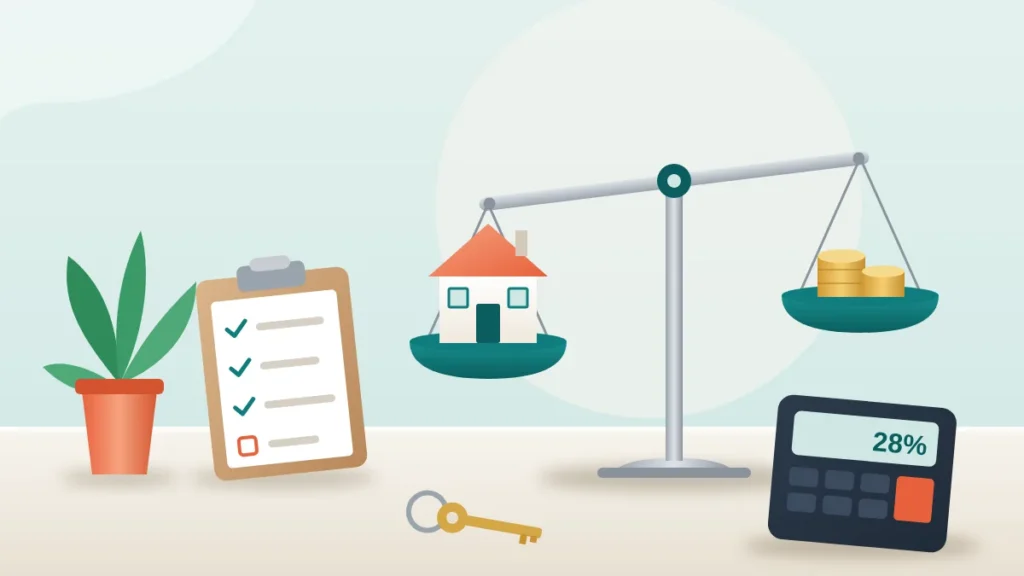
How much house you can afford depends mostly on your income, your existing debts, your down payment and the mortgage rate. Most lenders follow the 28/36 rule: housing costs up to 28% of gross monthly income and total debt payments up to 36%. On $96,000 a year with $600 of other debts, that points to a home of roughly $296,000 at 6.5%.
That figure is a ceiling, not a target. Lenders approve the maximum they think you can repay; they do not know about your childcare costs, your retirement goals or the car that is about to need replacing. This guide shows how the lender’s math works, how to run it on your own numbers with our home affordability calculator, and how to stress-test the answer so the house fits your life rather than just your approval letter.
The 28/36 rule explained
The 28/36 rule uses two tests, and the lower result wins.
- Front-end ratio (28%). Your total housing payment (principal, interest, property tax, homeowner’s insurance, mortgage insurance and HOA dues) should not exceed 28% of gross monthly income.
- Back-end ratio (36%). Housing plus every other monthly debt payment (car loans, student loans, credit card minimums, personal loans, child support) should not exceed 36% of gross monthly income.
Gross means before taxes and deductions. Everyday spending like groceries, utilities and phone bills does not count as debt for this test.
These are guidelines, not laws. Conventional loans often allow a back-end ratio up to 45% or even 50% with strong credit and cash reserves, and FHA loans regularly go to 43% or higher. A higher limit makes you eligible for a bigger loan, but it does not make the payment easier to live with. The Consumer Financial Protection Bureau’s Buying a House guide is a good, neutral walk-through of the whole process.
Debt-to-income ratio (DTI)
Your back-end ratio is the same thing as your debt-to-income ratio, or DTI. To calculate it, add up all monthly debt payments including the new mortgage and divide by gross monthly income. Someone earning $8,000 a month with $600 of car and student loan payments and a planned $2,240 housing payment has a DTI of ($600 + $2,240) ÷ $8,000 = 35.5%. The debt-to-income calculator does this for you and shows where you stand against common lender limits.
How much house can I afford? A worked example
Here is the full calculation for a household with these numbers:
- Gross income: $96,000 a year, or $8,000 a month.
- Other debts: $400 car payment + $200 student loan = $600 a month.
- Savings: $60,000, of which $50,000 can go toward the down payment and closing costs (keeping $10,000 as an emergency fund).
- Mortgage: 30-year fixed at 6.5%.
- Property tax $350 a month and homeowner’s insurance $150 a month, $500 together.
- PMI at 0.6% of the loan a year, since the down payment will be under 20%.
- Closing costs of 3% of the price.
Step 1: Apply both ratios
28% of $8,000 is $2,240. For the back-end test, 36% of $8,000 is $2,880, minus the $600 of existing debts, leaves $2,280. The lower of the two is $2,240, so that is the most you should spend on housing each month.
Step 2: Subtract taxes and insurance
$2,240 − $500 = $1,740 left for principal, interest and PMI.
Step 3: Work out the maximum loan
We need the loan amount where the monthly principal and interest at 6.5% plus PMI at 0.6% a year equals $1,740. That is a loan of about $255,100: principal and interest of $1,612.45 plus PMI of $127.55.
Step 4: Add the down payment, minus closing costs
With $50,000 of cash, about $8,900 goes to closing costs (3% of the price) and about $41,100 goes to the down payment. Price = loan + down payment, which gives a maximum price of about $296,200, with roughly 13.9% down.
| Item | Amount |
|---|---|
| Maximum housing payment (28% of $8,000) | $2,240 |
| Property tax + insurance | $500 |
| Principal and interest | $1,612 |
| PMI | $128 |
| Maximum loan | $255,100 |
| Down payment | $41,100 |
| Closing costs | $8,900 |
| Maximum home price | $296,200 |
If the lender allowed a 43% back-end ratio, the maximum housing payment would rise to $2,840 and the price ceiling to roughly $381,600. That is $85,000 more house on the same income. Whether you should take it is a separate question, covered below. For the payment formula behind Step 3, see our guide on how to calculate a mortgage payment.
How interest rates change what you can afford
The rate has a big effect on the price ceiling because the same monthly budget supports a smaller loan as rates rise. Holding everything else in our example constant:
| Mortgage rate | Maximum loan | Maximum price |
|---|---|---|
| 5.5% | $281,650 | $321,990 |
| 6.0% | $267,878 | $308,619 |
| 6.5% | $255,107 | $296,220 |
| 7.0% | $243,254 | $284,712 |
| 7.5% | $232,243 | $274,023 |
Each half-point move shifts the budget by about $11,000 to $13,000. Freddie Mac’s weekly Primary Mortgage Market Survey shows where average 30-year rates are right now. When you compare quotes, look at the APR rather than the headline rate, because it includes lender fees; our guide to APR vs APY explains why.
Down payment, PMI and closing costs
You do not need 20% down to buy a home. Conventional loans start at 3% to 5% down, FHA loans at 3.5%, and VA and USDA loans can require nothing down for eligible buyers. But the size of the down payment affects three things.
- The loan amount. Every dollar you put down is a dollar you do not borrow at 6.5% for 30 years.
- Mortgage insurance. Conventional loans with less than 20% down carry PMI, typically 0.3% to 1.5% of the loan a year, until you reach about 20% to 22% equity. FHA loans have their own mortgage insurance premium, which often lasts the life of the loan. Estimate yours with the PMI calculator or compare government-backed options with the FHA loan calculator.
- Your cash cushion. Putting 20% down on our example house would take about $59,200, plus $8,900 of closing costs, or $68,100 in total. That is more than the household has, and draining every dollar for a bigger down payment leaves nothing for repairs.
Closing costs usually run 2% to 5% of the price and cover lender fees, appraisal, title insurance, prepaid taxes and insurance. Budget for them separately from the down payment. The down payment calculator helps you split your savings between the two.
Costs the lender does not count
The 28/36 rule ignores several real costs of owning a home. Add them up before you decide what you can comfortably pay.
- Maintenance and repairs. A common rule is 1% to 2% of the home’s value a year. On a $296,000 house, 1% is about $247 a month.
- Utilities. A house usually costs more to heat, cool and water than an apartment.
- HOA dues, if any. These do count toward your ratio, so include them in the calculation.
- Rising taxes and insurance. Your principal and interest are fixed on a fixed-rate loan, but your escrow payment is not. Insurance premiums in particular have climbed fast in many states.
- Furniture, moving and the first round of fixes, which can easily run several thousand dollars in the first year.
Add $247 of maintenance to our $2,240 payment and the true monthly cost of the house is closer to $2,487. The mortgage calculator with taxes and insurance puts all of these lines in one place.
Stress-test your budget
The lender’s math is based on gross income. You live on take-home pay. Before you commit, run your plan through a few tough but realistic scenarios.
- Check the payment against take-home pay. On $96,000 gross, take-home after taxes and a modest retirement contribution might be roughly $6,000 a month. A $2,487 all-in housing cost is about 41% of that. Many people find 25% to 35% of take-home more comfortable. The 50/30/20 budget calculator shows how housing fits alongside other needs, wants and savings.
- Live on the new payment before you buy. If you rent for $1,600 now, put the $887 difference into savings every month for three to six months. If that feels tight, the house will feel tighter.
- Imagine a 20% income drop. If one earner lost hours or a job, could you still cover the mortgage for six months from savings?
- Check an adjustable rate’s worst case. If you are considering an ARM, work out the payment at the first possible adjustment cap. On our example loan, a jump from 6.5% to 7.5% would push the payment from $2,240 to about $2,411.
- Keep reserves after closing. Three to six months of expenses in cash is a sensible minimum for homeowners, separate from the down payment.
If you are still deciding whether to buy at all, the rent or buy calculator compares the long-run cost of each path. And if credit card or car debt is pushing your back-end ratio up, paying some of it down before you apply can raise your budget more than a raise would. Our guide to debt snowball vs avalanche covers the fastest ways to do that. This guide is general information, not personal financial advice; a HUD-approved housing counselor or a trusted lender can look at your full picture.
Quick tips before you start house hunting
- Get pre-approved rather than pre-qualified, so you know the lender has checked your income and credit.
- Set your own maximum price below the pre-approval figure and tell your agent that number, not the lender’s.
- Raise your credit score before applying if you can; a better score lowers both your rate and your PMI.
- Avoid new debt, such as a car loan or store card, between pre-approval and closing.
- Look up actual property tax rates for the towns you are considering; they can differ by thousands of dollars a year.
Frequently asked questions
How much house can I afford on a $100,000 salary?
With no other debts, the 28% rule allows a housing payment of about $2,333 a month. At 6.5% with $500 a month of taxes and insurance, PMI and 10% to 15% down, that supports a home of roughly $300,000 to $315,000, less if you have car or student loan payments or high property taxes.
Is the 3x income rule accurate?
Buying a home worth about three times your gross income is a rough shortcut. It ignores rates, debts and taxes, which matter more. At today’s rates, 3x income is often close to the 28/36 answer for buyers with little other debt, but it can be far off in high-tax areas.
Does the 28% include property taxes and insurance?
Yes. The front-end ratio covers the full housing payment: principal, interest, property tax, homeowner’s insurance, mortgage insurance and any HOA dues.
What DTI do lenders allow?
Many conventional lenders prefer 36% or less but may approve up to 45% to 50% with strong credit and reserves. FHA guidelines commonly allow around 43%, and sometimes higher with compensating factors.
Should I buy the most expensive house I qualify for?
Usually not. Approval limits do not account for savings goals, childcare, maintenance or a drop in income. Choosing a home that keeps your payment comfortably below the limit gives you room to save and to handle surprises.
The right budget is the one that lets you sleep at night and still save for the future. Start with the 28/36 rule to find the ceiling, subtract the costs the lender ignores, test it against your take-home pay and a bad month or two, and then shop for a home comfortably below the number. Run your figures through the mortgage calculator for each house you are serious about before you make an offer.