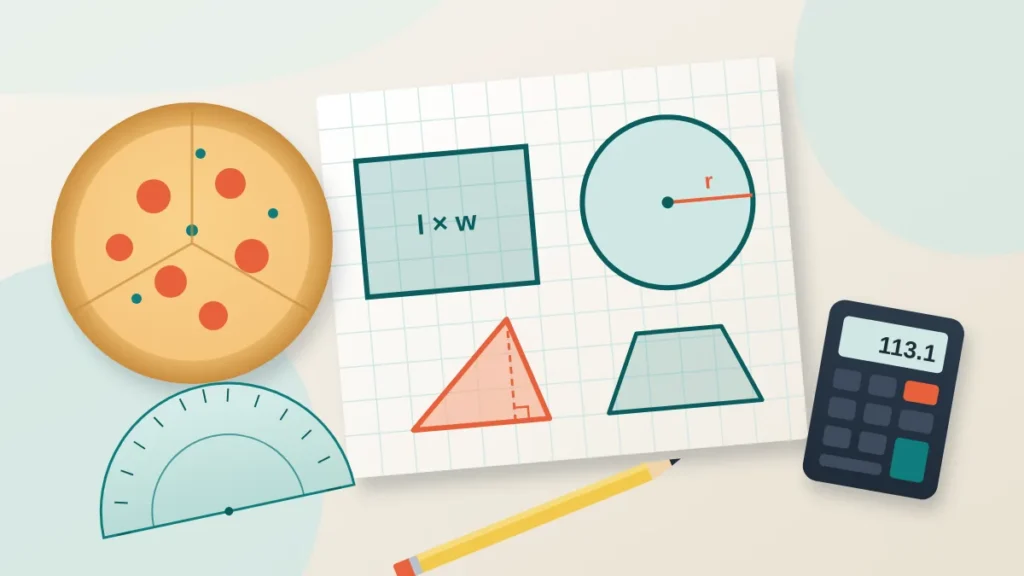
To find the area of a flat shape, measure two lengths at right angles and use the shape’s formula: length × width for a rectangle, 1/2 × base × height for a triangle, and πr² for a circle. The result is always in square units, such as square feet (ft²) or square meters (m²).
Below you will find every common formula with a worked example, the radius versus diameter question that trips people up with circles, how to split awkward shapes into easy ones, and how to find the surface area of boxes, cans and balls. If you would rather skip the arithmetic, the area calculator covers 17 shapes and converts between units.
What area means and why it is in square units
Area is the amount of flat surface inside a boundary. Think of it as the number of 1 × 1 tiles you would need to cover the shape. A floor 12 ft by 14.5 ft needs 174 tiles that are 1 ft square, so its area is 174 ft².
Because you multiply one length by another, the units multiply too: feet × feet = square feet, and centimeters × centimeters = cm². This is why a square foot holds 144 square inches (12 × 12), not 12, and why a square meter is 10,000 cm². Perimeter, by contrast, is the distance around the edge and stays in plain feet or meters. Mixing the two up is a common mistake when ordering fencing versus sod.
Every area formula is built on one idea: the rectangle. A parallelogram is a rectangle with one end sliced off and moved. A triangle is half a parallelogram. A trapezoid is the average of two parallel sides times the height. Once you see that, the formulas stop feeling like separate facts to memorize.
Area formulas for common shapes
In this table, h always means the perpendicular height: the straight-line distance between the base and the opposite side or point, measured at a right angle to the base.
| Shape | Formula | Example | Area |
|---|---|---|---|
| Square | A = s² | s = 9 ft | 81 ft² |
| Rectangle | A = l × w | 12 × 14.5 ft | 174 ft² |
| Triangle | A = 1/2 × b × h | b = 9 cm, h = 6 cm | 27 cm² |
| Circle | A = πr² | r = 6 in | 113.1 in² |
| Parallelogram | A = b × h | b = 8 m, h = 5 m | 40 m² |
| Trapezoid | A = (a + b) ÷ 2 × h | a = 10, b = 6, h = 4 ft | 32 ft² |
| Sector of a circle | A = (θ ÷ 360) × πr² | θ = 90°, r = 10 cm | 78.5 cm² |
How to find the area of rectangles and squares
Multiply length by width. That is the entire method, and it is the one you will use most, for rooms, rugs, walls, garden beds and sheets of plywood.
Worked example: a bedroom measures 12 ft by 14 ft 6 in. First convert 6 in to 0.5 ft, so the length is 14.5 ft. Then 12 × 14.5 = 174 ft². In metric, that is 174 × 0.0929 = 16.2 m². Measure wall to wall at floor level, and if the room is slightly out of square, measure each side twice and use the averages. The rectangle calculator also gives the perimeter and diagonal, which is handy for baseboards and for checking square corners.
A square is a rectangle with equal sides, so A = s². A 9 ft square patio is 81 ft². Going the other way, a square with an area of 50 m² has sides of √50 = 7.07 m.
Triangles: base and perpendicular height
A triangle is half of a parallelogram with the same base and height, so A = 1/2 × b × h. The height must be perpendicular to the base you chose. On a right triangle, the two legs are already at right angles, so you can use them directly. On other triangles, the height is often a line you have to draw inside (or even outside) the shape.
Worked example: the gable end of a house is 24 ft wide and rises 6 ft to the peak. Its area is 1/2 × 24 × 6 = 72 ft², which is the figure you need for siding or paint on that triangle.
When you only know the three sides
Use Heron’s formula. Find the semi-perimeter s = (a + b + c) ÷ 2, then A = √(s(s − a)(s − b)(s − c)). For sides of 13, 14 and 15 m: s = 21, and A = √(21 × 8 × 7 × 6) = √7,056 = 84 m². The triangle area calculator accepts base and height, three sides, or two sides and the angle between them.
Circles: radius vs diameter
The area of a circle is A = πr², where r is the radius, the distance from the center to the edge. The diameter is the full width across, which is twice the radius. Most real measurements, such as a pizza, a round table or a pipe, give you the diameter, so halve it first. If you plug the diameter straight into πr², your answer is four times too big.
If the formula you have uses diameter, it is A = πd² ÷ 4. Both give the same result. Use whichever matches the number you actually measured.
Worked example: is one 18-inch pizza more food than two 12-inch pizzas?
- 18-inch: r = 9, so A = π × 81 = 254.5 in².
- 12-inch: r = 6, so A = π × 36 = 113.1 in², and two of them make 226.2 in².
The single large pizza wins by about 28 in², because area grows with the square of the radius. If you only know the distance around the circle, divide the circumference by 2π to get the radius: a circumference of 50.27 in gives r = 8 in. The area of a circle calculator starts from radius, diameter or circumference, and the circumference calculator handles the reverse.
Trapezoids and parallelograms
Parallelogram
A = b × h. The trap is using the slanted side instead of the height. A parallelogram with a base of 8 m, slanted sides of 6 m and a perpendicular height of 5 m has an area of 8 × 5 = 40 m², not 48 m². Picture cutting the triangle off one end and sliding it to the other: you get an 8 × 5 rectangle. The parallelogram calculator works from base and height or from two sides and an angle.
Trapezoid
A trapezoid has two parallel sides of different lengths, a and b. Average them and multiply by the perpendicular height: A = (a + b) ÷ 2 × h. A flower bed with parallel edges of 10 ft and 6 ft, 4 ft apart, covers (10 + 6) ÷ 2 × 4 = 32 ft². Lots, retaining wall faces and the side of a sloped deck are often trapezoids. Our trapezoid calculator also finds the legs and angles.
Composite and irregular shapes
Most real rooms and yards are not one neat shape. Split them into rectangles, triangles and circles, find each area, then add (or subtract for cutouts).
Worked example: an L-shaped living area. Split it into a 20 × 12 ft rectangle and a 10 × 8 ft rectangle. The total is 240 + 80 = 320 ft². If a 3 ft round column sits in the middle and you are buying flooring, subtract π × 1.5² = 7.1 ft², though in practice you would not bother for a small cutout since you need waste allowance anyway.
For a plot with many straight sides and no right angles, use the coordinates of the corners and the shoelace method; the irregular polygon area calculator does this for you. For flooring jobs specifically, our guide on how to calculate square footage covers waste factors and whole-house measurements, and the square footage calculator adds up several rooms at once.
Surface area of common solids
Surface area is the total area of every face of a 3D object: the wrapping paper on a box, the paint on a tank, the sheet metal in a can. You find it by unfolding the solid in your head into flat shapes and adding their areas.
| Solid | Surface area formula | Example | Result |
|---|---|---|---|
| Cube | 6a² | a = 5 cm | 150 cm² |
| Box (rectangular prism) | 2(lw + lh + wh) | 12 × 10 × 6 in | 504 in² |
| Cylinder | 2πr(r + h) | r = 3, h = 11 cm | 263.9 cm² |
| Sphere | 4πr² | r = 12 cm | 1,809.6 cm² |
| Cone | πr(r + s), s = slant height | r = 3, s = 5 cm | 75.4 cm² |
Worked example: you want to paint the outside wall and top of a round water tank 1.5 m in radius and 2 m tall, but not the bottom. The side is 2π × 1.5 × 2 = 18.85 m², and the lid is π × 1.5² = 7.07 m², for a total of 25.9 m². At a typical coverage of about 10 m² per liter per coat, two coats need roughly 5.2 L. Our guide on how much paint you need explains coverage rates in detail, and the surface area calculator covers ten solids. For the space inside these shapes instead, see how to find the volume.
Converting square units and common mistakes
Area conversions use the linear factor squared. Since 1 ft = 0.3048 m exactly (as defined by NIST), 1 ft² = 0.3048² = 0.0929 m², and 1 m² = 10.764 ft².
| Unit | Equals |
|---|---|
| 1 ft² | 144 in² = 0.0929 m² |
| 1 yd² | 9 ft² = 0.8361 m² |
| 1 m² | 10.764 ft² = 10,000 cm² |
| 1 acre | 43,560 ft² = 4,046.9 m² |
| 1 hectare | 10,000 m² = 2.471 acres |
The area converter handles these and regional units too. The mistakes worth watching for:
- Converting square units with a linear factor, such as dividing square inches by 12 instead of 144.
- Using the diameter in πr², which makes a circle four times too large.
- Using a slanted side as the height of a triangle, parallelogram or trapezoid.
- Mixing feet and inches in one multiplication. Convert 14 ft 6 in to 14.5 ft first.
- Rounding measurements too early. Round only the final answer.
- Confusing area with perimeter when buying edging, fencing or trim.
Frequently asked questions
What is the basic formula for area?
For a rectangle it is length × width. Every other common formula is a variation of that, such as half of base × height for a triangle or πr² for a circle.
Do I use the radius or diameter to find the area of a circle?
The standard formula πr² uses the radius, so halve the diameter first. If you prefer to use the diameter directly, use πd² ÷ 4.
Why is area measured in square units?
You multiply two lengths, so the units multiply as well: feet × feet gives square feet. Each square unit is a tile one unit on each side.
What is the difference between area and surface area?
Area describes a flat, two-dimensional shape. Surface area is the sum of the areas of all the faces of a three-dimensional object.
How do I find the area of an irregular shape?
Split it into rectangles, triangles and circle parts, calculate each one and add them. For a many-sided plot, the corner coordinates and the shoelace formula give an exact answer.
Finding area comes down to three habits: pick the right formula, use the perpendicular height and the radius, and keep every measurement in the same unit until the end. Do that and the answer will be right whether you are pricing a carpet, comparing pizzas or checking homework. For more practice problems, the free OpenStax Prealgebra 2e textbook has a full chapter on perimeter and area.